Writing an Accident Report

Accident Reporting - Why ?

In a workplace accident book, all details of any accidents and injuries should be recorded. This includes minor cuts and burns, trips and falls, serious cases of illness and serious accidents and injuries. Someone, often the first aider attending the incident, should be in charge of recording information in the accident book, and this person should be noting down:

The date, time and place of the accident.

What happened in as much detail as possible, including where and how the accident happened, extent of injuries, what first aid was given and happened to the casualty afterwards (i.e. they were taken to hospital).  

The contact details, age and gender of the casualties, and if possible, signatures of the casualties.

The contact details and signature of the person in charge of the incident (i.e. the designated first aider).

Contact details of any witnesses to the accident (and to the treatment if possible).


Why is the accident book important?

There are a few reasons why an accident book is essential. The information in the book can help to identify risks and accident trends, which can help to prevent accidents in the future. The accident book can also help in cases where the injured person decides to pursue compensation, or when the company or event organiser is being investigated for potentially breaching health and safety regulations.

Adapted from http://www.tutorcare.co.uk/traininghub/importance-recording-accidents-injuries-work
What makes a 'good' report ? 
The devil is in the detail !  If you are a first aider at your place of work, or are a first aider at a 'one off' event, the event organiser, or your employer, should have a first aid policy, and should have some means of recording and accidents or incidents, usually some kind of form which the first aider completes.  These forms will/should ask all the correct questions, and should equip the organiser or employer with all the information they need to know after the event.

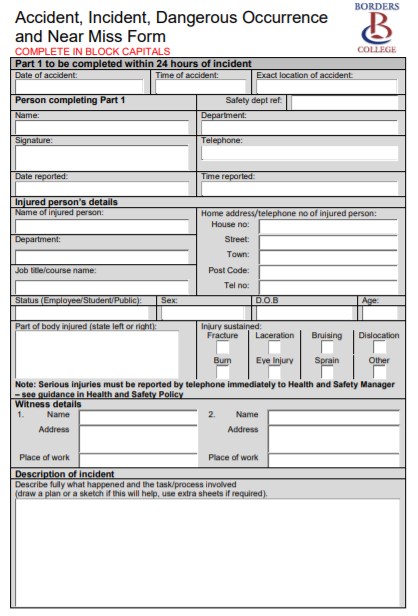
Your responsibility is to make sure you complete the form fully and accurately.  Doing so is part of your Duty of Care, and, as we are now aware, these forms may constitute evidence in a court should there be any allegations of negligence or inappropriate treatment.  To see an example of a form, you can download a copy of the Borders College accident form here.

It is good practice to familiarise yourself with what information is required for the form, as, often, the form is not filled in until after you have provided first aid to the casualty.  This may mean, if, for example,  they have been transferred to hospital, that they will be unable to provide you with some of the information that may be required, or to sign the form.  By familiarising yourself with what is required, you can ask the various questions during treatment, and then complete the form as soon as possible after completing treatment.

For more information on Accident Reporting, please refer to pages 27 - 30 of your course reader.
© Copyright Simon Watson